Last week my wife and I watched Sam Mendes’s 2019 Oscar-nominated film 1917. It was compelling and gripping, as much a race-against-the-clock thriller as a war movie, and it was a top-notch film by any measure — story, performances, cinematography. But what made it ground-breaking was its presentation as a single, two-hour-long tracking shot. (Actually, there’s one visible cut in the movie when a character is knocked out and the film jumps to the moment when he regains consciousness.)
Fortunately, we watched the movie on a Blu-ray disk rather than on streaming, so when it was over we were able to watch the making-of featurettes included on the disk. I don’t often watch those, and this was the first time that I’ve found the extras to be every bit as interesting as the movie itself.
The movie was not actually filmed as one or two long takes, but each of its scenes, up to nine minutes long, was filmed continuously, which required exceptionally meticulous planning and rehearsal, and the use of unprecedented cinematographic techniques and technologies.
In a traditional movie, of course, the camera is used in multiple ways: wide cinematic scenes establish the setting, closer shots capture the action, and close-ups show the emotions on the performers’ faces. In 1917, Mendes and his crew had to accomplish all those things but without cutting from take to take. They persuaded the camera manufacturer ARRI to let them use a new type of camera that was still in prototype and paired it with an electronically-stabilized, remote-controlled head called a Stabileye.
A camera operator was able to run forward down a trench with the camera pointing backwards at the actors, then hook it to a boom attached to a crane that would lift it high above the ground for an aerial view, all while continuously shooting the action.
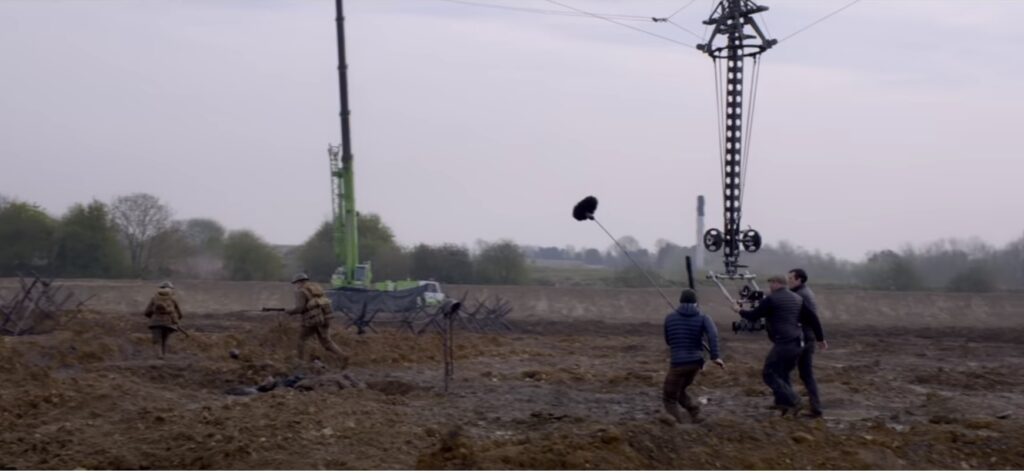
Because each scene was shot in real time, the distance covered by the actors had to exactly match the timing of the action and dialog. If the script was longer than the terrain or the terrain was longer the script, the scene wouldn’t work.
The story and performances in 1917 are so good that I often got lost in the movie and didn’t think to marvel at its cinematic accomplishments, but the extras on the disk pulled back the curtain and described the jaw-dropping degree of innovation and detailed planning required to pull it off.
I discovered later that one of those making-of featurettes is available on YouTube.