Before neural scanning technologies were developed that allowed the workings of the human brain to be observed in real time, neuroscientists had preconceived notions about what this kind of imaging would reveal. They speculated that different kinds of tasks engaged different parts of the brain — emotional responses to a romantic movie, for example, would involve brain activity in a different region than, say, working on a math problem.
What neural scanning ultimately revealed was that different kinds of cognitive activity invoke not different regions in the brain but rather distinct networks, in which interconnected sets of neurons spanning the entire brain work in concert.
But what most surprised scientists was what neural scans showed when the brain wasn’t engaged with much of anything — when the subject wasn’t being stimulated at all and actually experienced being bored.
The assumption had been that the brain under these circumstances is relatively quiet, with much less neural activity than when it is engaged. But instead scans revealed a network in the brain that lit up like crazy when, to all outward appearances, nothing much was happening. Scientists called this the “default network,” since it’s the network that’s active by default, when the brain isn’t being called upon to deal with outside stimuli.
Of course this raised the question of what that activity was all about. What is the brain doing when the default network is engaged? While I don’t think that question has been definitively answered, subsequent studies have demonstrated that there is a correlation between the amount of time that our default network is active and how creative we are. When our mind is wandering, when we’re daydreaming, when we’re just plain bored, valuable things are happening in our heads that boost our ability to be creative and solve problems.
Of course, with the introduction of social media and then the smart phone, boredom for the most part became obsolete.
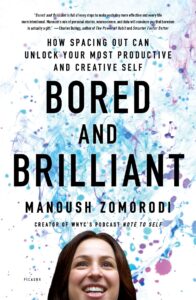
Manoush Zomorodi talked often about this phenomenon on her Note to Self podcast. She created a challenge for her listeners called “Bored and Brilliant,” in which she encouraged them to spend less time with their digital devices in the interest of boosting their creativity. She subsequently wrote a book about the results of that challenge called Bored and Brilliant: How Spacing Out Can Unlock Your Most Productive and Creative Self.
Over the last couple of years I’ve tried to ensure that I get some time each day alone with my thoughts. Running errands in the car provides an opportunity; I used to always listen to podcasts or public radio while driving, but now I often drive in silence. Of course, when I’m driving, I am doing something — it’s not the same as sitting and staring at a wall — so perhaps if I really want to foster my creativity, I’ll need to seek out other opportunities to get bored. Suggestions are welcome.