Yesterday I wrote about how Cal Newport diverges from David Allen’s GTD orthodoxy regarding how to make the best use of your workday. Even though I’m mostly retired, I decided to experiment with the approach Newport recommends, which he calls “time-blocking.”
For the last few days I’ve been sitting down after breakfast and planning my day by allocating blocks of time to the various activities and projects I want to work on. To be clear, Newport does not suggest that we time-block every waking hour; he recommends time-blocking only the workday. But since I don’t have a “workday” in the usual sense of the word, and since this was an experiment, I decided to time-block my entire day.
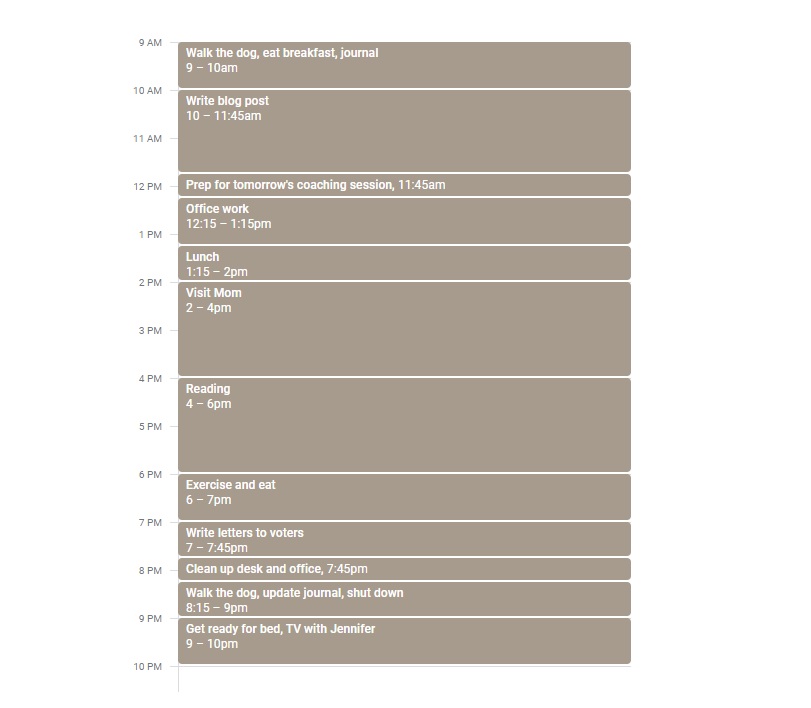
Newport suggests using a physical notebook for time blocking (he just started selling a Time-Block Planner for this purpose), but I decided to do it digitally. I use Google’s calendar to manage my appointments, and Google lets you create multiple calendars, each of which appears in a different color, so I created a new calendar just for time blocking. The accompanying photo shows a typical day.
The biggest insight this exercise has yielded is just how much of my day is already allocated to the things I’ve decided to do on a daily basis. Even aside from such unavoidable activities as eating, sleeping and walking the dog, my daily routine includes writing a blog post, doing some journaling, and spending time with my mother. I also try to allocate a couple of hours to reading, and most days I do some kind of exercise. Of course, there’s usually some office work, like paying bills, and lately I’ve been writing letters or postcards to voters in Georgia encouraging them to vote in the upcoming Senate runoff elections. And that’s just the daily stuff; there are also things I do on a weekly basis, like my executive coaching and literacy tutoring.
In short, even before I sit down to time-block my day, most of the day is spoken for. There’s only an hour or two left for non-routine activities. That isn’t necessarily a problem — all the things I’m doing are things I want to do, and it’s not as if there’s a host of other activities tempting me out of the house during the pandemic — but it’s eye-opening because, since my semi-retirement, I’ve been in the habit of assuming that my schedule is unconstrained, that I have plenty of discretionary time. In fact, while most of my time is discretionary, I’ve already exercised that discretion by resolving to do a bunch of things on a daily basis.
Time blocking has thus illuminated the fact that when I choose to commit to something new, I’m not committing unallocated time; I’m committing to not do something that I previously decided to do. It has also gotten me thinking that maybe the things I’ve been doing on a daily basis don’t all need to be done every single day. Maybe I should take a day off each week from one or more of them and free up time to do something entirely different — a special project or some fun activity that I don’t typically do.
The other thing I’ve learned from my time-blocking experiment is that Cal Newport is right: I’m getting more done now that I’m time-blocking than I did before. I’m less inclined to spend time on easy but low-value activities. If I had done time-blocking when I was working full-time, I believe it would have made me more productive.
If you’re interested in doing your own experiment with time-blocking, you can Google it and find lots of enthusiastic advice and suggestions.