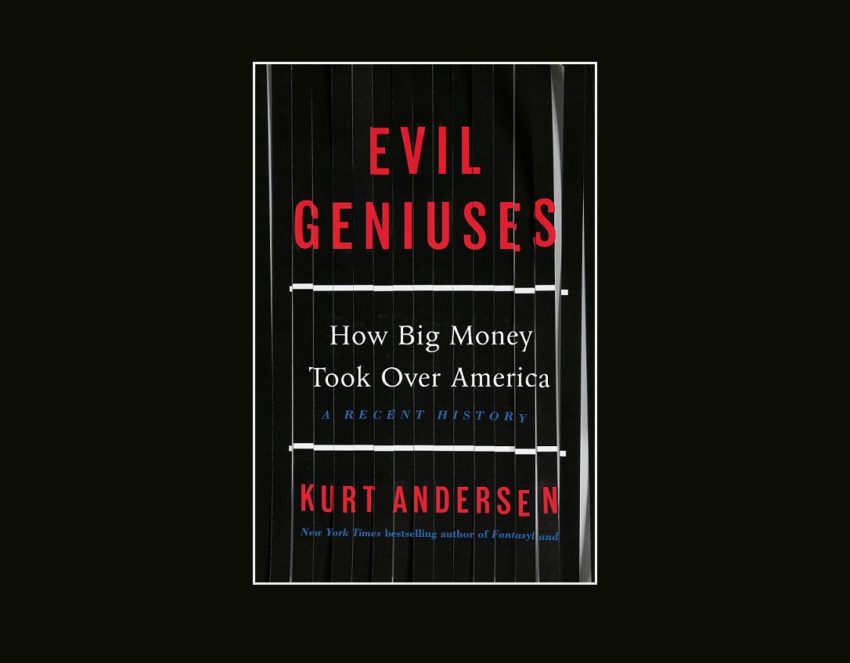
I just finished reading Evil Geniuses: The Unmaking of America – A Recent History by Kurt Andersen. The primary thesis of this book is similar to that of Robert Reich’s book, The System: Who Rigged It and How to Fix It, which I read and blogged about a couple of months ago. But Evil Geniuses is a longer and more ambitious book. Andersen tells the story of how conservatives in America — specifically CEOs, conservative politicians and academics, and some hugely wealthy people — set about in the 1970s to change the minds of Americans about the nature of markets, the source of American prosperity, and the role of government in managing the economy. It’s a fascinating story, and one I’ve never seen told in such journalistic detail.
But there is a second thesis in Andersen’s book. He asserts that at around the same time the United States took a hard right turn starting in 1980, something significant also occurred culturally in our country. Specifically, he proposes, America, which until that time had always been a country that embraced the new, backed away from that inclination. We became more nostalgic for an imagined past that was safer, happier, and less fraught.
The most striking evidence of this shift is the degree to which innovation and change in all aspects of our culture — fashion, hairstyles, music, automobiles — slowed down or halted. Andersen notes that until late in the twentieth century, if we were to compare photographs of Americans from any two points in time just a generation apart, the differences would be striking. A typical family in the 1930s would look antiquated to someone in the ’50s. And the appearance of that 1950s person would look equally dated to someone in the ’70s. But that was no longer the case by the time we reached the turn of the century. As Andersen writes,
In any year during the twentieth century, if somebody on an American city street were dressed and groomed in the manner of someone from twenty or twenty-five years earlier, they would’ve looked like an actor in costume or a time traveler. Whereas if every second pedestrian you passed today actually was a time traveler fresh from 2000, you’d really have no clue, even if one of them were speaking on her (cool vintage) cellphone.
So what’s the significance of that? This is where I found Andersen’s thesis a little hard to follow. He suggests that from the days of its founding into the 1960s, America’s default setting was an openness to the new. But then things got scary. Between the threat of nuclear annihilation, race riots and assassinations, Vietnam and Watergate, rampant inflation and the oil crisis, Americans started to reconsider their assumption that the country was moving in a positive direction. Change was not necessarily synonymous with progress. This led to a rise in nostalgia and a reluctance to embrace the new.
I confess I don’t fully understand how Andersen’s two theses — the rise of the economic right and the slowing of cultural change — tie together. The connection seems to be clear to him but I didn’t entirely get it. Maybe I just don’t view cultural trends to be as significant as he does.
But leaving aside Andersen’s cultural observations, his recounting of the rise of economic conservatism, and the degree to which it was the product of a concerted, coordinated, well-funded, long-term strategy, is incisive.
In 1970 Milton Friedman, the University of Chicago libertarian economist, wrote an essay that was published in the New York Times under the headline, A Friedman Doctrine — The Social Responsibility of Business Is to Increase Its Profits. Andersen says it was “a cri de coeur for cold-heartedness.”
That same year, Lewis Powell, who would later become a Supreme Court justice, gave a speech at a big annual Southern business conference in which he warned that the U.S. political economy was “under broad and virulent attack” by left-wing radicals. He elaborated on that theme a year later in a memorandum for the U.S. Chamber of Commerce entitled “Attack on American Free Enterprise System,” in which he wrote, “One of the bewildering paradoxes of our time is the extent to which the enterprise system tolerates, if not participates in, its own destruction.” The memo was widely circulated and served as a call to arms to CEOs and wealthy conservatives that they had to invest in fighting a war against economic progressivism.
Over subsequent years, billions of dollars were invested in funding political campaigns, establishing right-wing think tanks, and endowing academic chairs and entire departments. And it worked. The themes of this movement are today widely viewed as conventional wisdom: government isn’t the solution to the problem, it is the problem; the past was better than the present’ establishment experts can’t be trusted and science is suspect; an unbridled free market is the solution to every problem.
Along the way, the movement managed to co-opt well-intentioned neoliberals as what Andersen calls “useful idiots” to validate the right’s economic precepts. Democratic politicians, seeing that the tide of American opinion was turning away from FDR progressivism, went along. “The era of big government is over,” Bill Clinton pronounced in his 1996 State of the Union address.
All of which has brought us to the world we live in today, one in which government is bad, everyone is entitled to their own facts, short-term profits are everything, liberty means selfishness, inequality’s not so bad, and universal healthcare is tyranny.
Andersen makes a compelling case that the conservative economic consensus is a recipe for dystopia, but of course I was there already. What was new for me was his detailed historical recounting of how we got here. If that was all I took away from Evil Geniuses, I would have been grateful for the education but also even more demoralized than I was before. But Andersen ends on a hopeful note — and not a groundless one. In his penultimate chapter he points to evidence that Americans may be reconsidering the wisdom of unfettered markets and small government. He points to a number of surveys over the past few years and writes,
Several ask, are poor people poor because they’re “not doing enough to help themselves” or because of “circumstances beyond their control”? In 1995, Americans by two to one said it was mostly poor people’s fault. In the early 2000s, two different polls found that respondents were almost split evenly, and in 2018, in a survey by the conservative American Enterprise Institute, a solid majority, 55 percent, said that “circumstances beyond their control cause people to be poor.” A 2018 Gallup poll asked people if “the fact that some people in the United States are rich and others are poor needs to be fixed or is acceptable,” and a similar solid majority, 75 percent, said we need to reduce inequality.
Polls in 2019 found that by huge margins, three to one, Americans want more government regulation of Wall Street banks and believe that corporations pay too little in taxes. And three different polls in 2019, by The New York Times and Politico, asked people what they thought of proposals to impose a wealth tax on the extremely rich — a tax of 2 percent a year on all wealth between $50 million and $1 billion, 3 percent a year on everything over $1 billion. All three polls found that nearly two-third of Americans are in favor of such wealth taxes — including large majorities of Republicans.
So maybe there’s hope for a turn away from the rich-deserve-to-get-richer ethos that has dominated mainstream political economic thought for the last forty years. I recommend Evil Geniuses both for its illuminating history of the conservative political economic movement and for its hopeful suggestions as to where we might go from here.
I recommend “American Dialogue” by Joseph Ellis.