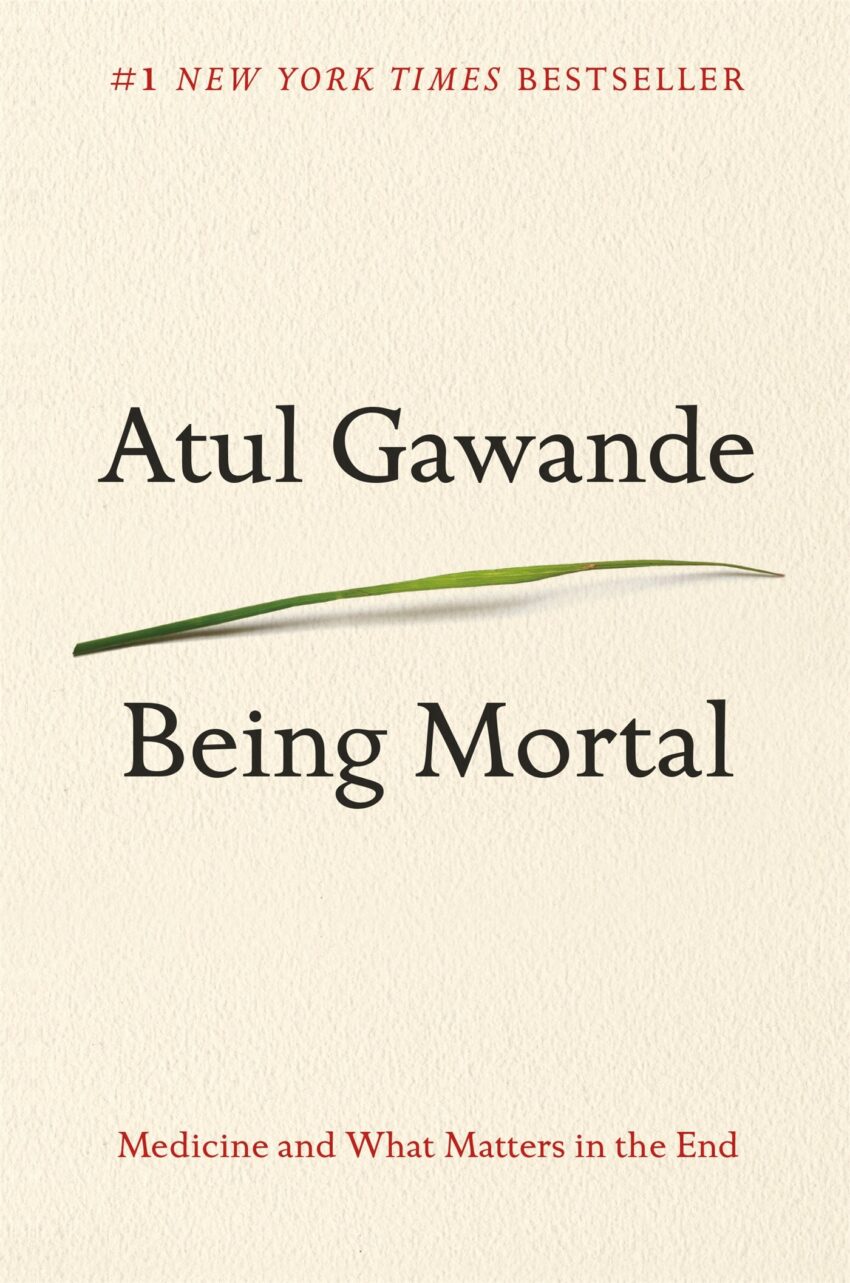
In deciding what to write about today, I asked myself whether there are any books I’ve read lately that I would recommend unconditionally. As I scanned my bookshelf, the one that jumped out was Being Mortal: Medicine and What Matters in the End by Atul Gawande. It’s a wonderful and thought-provoking look at how our society cares for — or fails to care for — its oldest and most infirm members.
Gawande is a rare breed: a surgeon who is also a best-selling author and staff writer for the New Yorker. His first book, Complications: A Surgeon’s Notes on an Imperfect Science was a finalist for the National Book Award. He subsequently wrote Better: A Surgeon’s Notes on Performance, which was selected by Amazon.com as one of the ten best books of 2007, and The Checklist Manifesto: How to Get Things Right, which made it onto the New York Times bestseller list. Being Mortal is his most recent book. In it he cites both research and personal experience to illuminate the suffering produced by our society’s approach to aging and death.
Gawande writes that for thousands of years, caring for those near the end of their lives was seen as a family and societal responsibility. Only in the 20th century in the western world did it come to be seen as a medical issue. This shift has had profound implications for end-of-life care. Doctors, of course, see their role as preventing death and disease. For many of them, nurturing and caring for someone through the process of dying isn’t what they became doctors to do, and isn’t in their comfort zone.
One of the most significant factors in the evolution of how we care for the elderly is the atomization of the family. In the days of extended families, there were usually one or more older people needing additional care, and enough other family members around to provide that care without anyone being overburdened. In the western world today there are few multigenerational families living together in a single homestead. Adult children of older people often live far from their parents. When such a parent becomes too old or infirm to take care of themselves, their only options are professional in-home assistance or institutional care.
Many older people muddle along on their own, some of them falling more and more often, until there is no choice but to move into a nursing home. But nursing homes typically regarding their residents offspring as their true clients, because those offspring often make the decision about which home their parent moves into. While the residents’ greatest priorities might be their own autonomy and quality of life, including friendships and engaging activities, the offsprings’ primary consideration is typically safety. They are entrusting the nursing home to provide the care they are not in a position to provide themselves, and the one thing they can’t abide is the thought of their parents getting hurt. Also, because many nursing homes are for-profit institutions, they keep staffing at the lowest level they can get away with. The priority of safety over quality of life combined with minimal staffing often results in residents’ movements being severely curtailed with the result that they are both lonely and bored out of their minds. In some case, nursing home residents are virtually prisoners in their own beds.
Being Mortal also deals with how we make decisions about the type and degree of medical care given to people who are dying or severely disabled by conditions, such as dementia, associated with old age. Such people are often subjected to invasive medical interventions that offer little hope of extending their lives, and only further degrade their quality of life. The reasons for this are complex. Among them is the mindset of many physicians, who see themselves as problem solvers and life savers. Another reason is an immature relationship to mortality in our society, in which death is viewed not as a natural part of life but as a tragedy to be deferred at almost any expense.
One of the key lessons in Being Mortal is that we need to have conversations with our parents, or other older people for whom we are responsible, about how they would want decisions made about medical interventions to extend their lives. For some, there is no point in living longer if they are no longer able to be a contributing member of society. Others are prepared to endure onerous treatments even it means only that they’ll be able to sit up in bed and watch TV. Many of us are faced with making decisions on our parents’ behalf without having learned what their wishes and priorities are.
Sooner or later, infirmity and death touches all of us. I wholeheartedly recommend Being Mortal as a guidebook of sorts for dealing with this inevitable aspect of life.