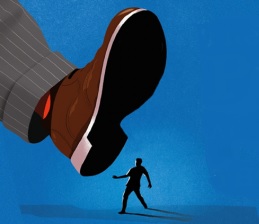
I just finished reading a book that blew my mind: The People, NO: A Brief History of Anti-Populism, by Thomas Frank, who is best-known for his 2004 book, What’s the Matter with Kansas?
The title is a play on a slogan of the People’s Party in the late 19th century: “The People, Yes!”As the book explains, the People’s Party was the first true populist movement in America, a coalition of farmers and laborers, blacks and whites, looking to topple the hegemony of wealthy capitalists and reclaim a fair share of the fruits of the American economy.
Since then, Frank explains, populism has been widely maligned by corporate leaders, academic elites, journalists and others. It has been mischaracterized as trouble-making by disgruntled, uneducated, bigoted, jingoistic, working class whites in rural parts of the country who are nostalgic for a prosperous and equitable past that never really existed, and who blame their misfortune on liberal elites who look down on them.
Frank’s historical description of populist movements in the United States, and the array of forces that have disparaged and misrepresented those movements, is interesting, but I found myself wondering at first what the relevance is today of a failed political/economic movement of the 1890s. Frank provides a multi-part answer.
First, while the People’s Party did not enjoy much electoral success, it did plant the seeds for a broad social and economic realignment — one that arguably reached its zenith during the administration of Franklin D. Roosevelt. Anti-trust laws were passed and enforced, union rights were strengthened, and legislation was enacted to halt the exploitation of American farmers.
But in the latter half of the twentieth century, and especially after 1980, those trends reversed. Conservatives succeeded at lowering top tax rates, weakening unions, reducing anti-trust enforcement, and dismantling regulations on the financial industry, all of which led to a stagnation of wages for workers and ever-increasing wealth and power for the most affluent Americans.
For me, the biggest epiphany in Frank’s book was his characterization of the Democratic Party as having failed working-class Americans. Frank describes how the Democratic leadership has come to view the struggles of the white working class as an unfortunate but inevitable result of global forces and technological progress, the hindrance of which would either undermine the country’s prosperity or be entirely futile. Rather than restructuring the financial industry after the great recession to ensure that it serves the interests of the majority of Americans, they settled for technocratic fiddling.
Frank also delivers a stinging rebuke to Democrats for having turned their party over to educated elites who scoff at the idea of allowing undereducated laborers a say in how the country is run. As they see it, those decisions need to be left to the experts — the professional economists and legal scholars that Democratic administrations have for decades brought to Washington to shape public policy.
These developments left working-class Americans disadvantaged, disenfranchised, and embittered, and thus open to the false promises of Donald Trump, who ran on what sounded like a true populist platform of reforming trade policy to preserve jobs and protecting Social Security. It was all a lie, of course, but many working Americans felt they had no better options.
And today, Frank asserts, Democrats are doubling down on their contempt for the white working class after Trump won the presidency in 2016. Frank writes,
For a certain kind of Democratic partisan, this development has had the predictable consequence of rendering unsayable anything that smacks of traditional class grievances. Talk about the deindustrialization of vast parts of the country, the decimation of unions, the destruction of small towns by monopoly forces, and this kind of person hears “Trump voter.” The enlightened liberal shuns such people. They are to be scolded, not championed.
What was revelatory for me about this depiction is that I recognized myself in it, as well as many of my progressive friends. “Stupid got him elected,” one close friend told me after Trump’s win. In this view, the people who voted for Trump did not do so because they had legitimate grievances that Trump promised to redress. They did so because they are ignorant, racist jerks.
I’ve long admired FDR’s progressive domestic agenda, and wondered why the modern-day Democratic Party doesn’t incorporate more of his policies into their electoral platform. I’m now inclined to think that centrist Democrats today (the only kind of Democrats that have been able to win a Presidential election since 1952) have drunk the free-market Kool-Aid. As they see it, to aggressively intervene in the workings of the economy as FDR did would be to risk undermining the source of our prosperity. The wealthy industrialists and bankers need to be left alone to do what they do, because what they do creates jobs and benefits all of us. I’ve concluded that’s rubbish. Some would say — with considerable contempt, no doubt — that makes me a socialist. Thomas Frank would suggest that makes me a true populist.
A great summary of an important book. Democrats need to realize that the scolding culture that holds sway in many parts of the Left does not win elections or persuade folks on the fence who may have different views to join their cause. I was chastened you recognize myself in Frank’s depiction of today’s Democratic Party that believes that the technocrats produced by the meritocracy are the only ones fit to govern the country. I’ve come to believe that Bernie Sanders might have won in 2016 with a genuine progressive Populist agenda if the Democratic establishment had provided a truly level playing field in the primaries. However you feel about Biden, he knows how to speak to working class voters. Let’s see if he’ll get a chance to right the ship from disaster.