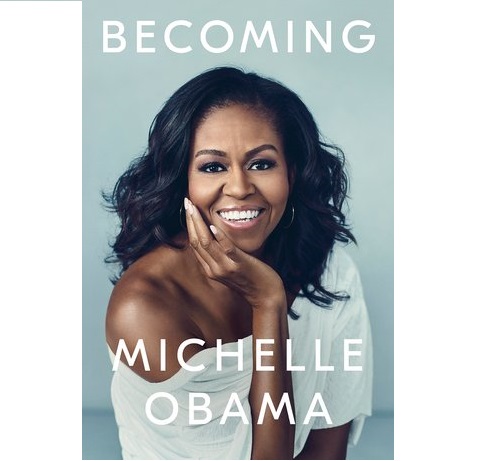
I just finished reading Michelle Obama’s memoir, Becoming. A friend of mine gave it to me as a gift when it first came out, and I finally picked it up two weeks ago after it had been on the bestseller list for 75 weeks.
I thought it would be…okay. It seemed like a book I should read, especially since it was a gift.
But it was, in a word, wonderful.
I read a lot. Over the past year I’ve read well-reviewed biographies of Winston Churchill, Frederick Douglas, and FDR. They were all well-researched and well-written, but I found reading them to be, at least to some extent, a bit of a slog. It took a certain amount of self-discipline to open those books each day and read at least a chapter or two. I thought maybe that was just the nature of biographies — a function of having to start at the beginning of someone’s life and recount it all in chronological order. Not all of it is going to be fascinating.
But Michelle Obama’s memoir was not like that. Even though it, too, starts at the beginning of her life and proceeds chronologically (in this case through the end of Barack Obama’s presidency), picking up the book each day felt like being tucked in and told a bedtime story. I was transported.
Maybe that’s because the author was telling her own story and not someone else’s. In any case, I found I was grateful to Michelle Obama for sharing her story with me.
In case you’re interested, I’m including a couple of longish excerpts that may give you a flavor of the book.
The first one takes place after Barack Obama was elected president in 2008 but before he took office. President George W. Bush and his wife Laura had invited the Obamas to drop by the White House for a visit. Michelle was already in Washington with her daughters looking at schools, and went to Reagan National Airport to meet her husband’s plane, accompanied by her newly assigned secret service detail led by an agent named Cornelius Southall.
Like all of my detail leaders, he was smart, trained to be hyperaware at every moment, a human sensor. Even then, as the two of us watched Barack’s plane taxi and come to a stop maybe twenty yards away on the tarmac, he was picking up on something before I did.
“Ma’am,” he said as some new piece of information arrived via his earpiece, “your life is about to change forever.”
When I looked at him quizzically, he added, “Just wait.”
He then pointed to the right, and I turned to look. Exactly on cue, something massive came around the corner: a snaking, vehicular army that included a phalanx of police cars and motorcycles, a number of black SUVs, two armored limousines with American flags mounted on their hoods, a hazmat mitigation truck, a counterassault team riding with machine guns visible, an ambulance, a signals truck equipped to detect incoming projectiles, several passenger vans, and another group of police escorts. The presidential motorcade. It was at least twenty vehicles long, moving in orchestrated formation, car after car after car, before finally the whole fleet rolled to a quiet halt, and the limos stopped directly in front of Barack’s parked plane.
I turned to Cornelius. “Is there a clown car?” I said. “Seriously, this is what he’s going to travel with now?”
He smiled. “Every day for his entire presidency, yes,” he said. “It’s going to look like this all the time.”
I took in the spectacle: thousands and thousands of pounds of metal, a squad of commandos, bulletproof everything. I had yet to grasp that Barack’s protection was still only half-visible. I didn’t know that he’d also, at all times, have a nearby helicopter ready to evacuate him, that sharpshooters would position themselves on rooftops along the routes he traveled, that a personal physician would always be with him in case of a medical problem, or that the vehicle he rode in contained a store of blood of the appropriate type in case he ever needed a transfusion. In a matter of weeks, just ahead of Barack’s inauguration, the presidential limo would be upgraded to a newer model—aptly named the Beast—a seven-ton tank disguised as a luxury vehicle, tricked out with hidden tear-gas cannons, rupture-proof tires, and a sealed ventilation system meant to get him through a biological or chemical attack.
I was now married to one of the most heavily guarded human beings on earth. It was simultaneously relieving and distressing.
I looked to Cornelius, who waved me forward in the direction of the limo.
“You can head over now, ma’am,” he said.
The other excerpt is from close to the end of the book, the day of the funeral service for Clementa Pickney, who had been one of nine people killed by Dylan Roof. President Obama had delivered the eulogy, after which he’d led the congregation in a soulful rendition of “Amazing Grace.” In contrast to the solemn events of the day, that evening in Washington was marked by celebrations of the Supreme Court’s landmark ruling affirming that same-sex couples had the right to marry in all 50 states.
On and off over the course of the day, I’d caught reports of Americans overjoyed by the news. A jubilant crowd chanted, “Love has won!” on the steps of the Supreme Court. Couples were flocking to city balls and county courthouses to exercise what was now a constitutional right. Gay bars were opening early. Rainbow flags waved on street corners around the country.
All this had helped buoy us through a sad day in South Carolina. Returning home to the White House, we’d changed out of our funeral clothes, had a quick dinner with the girls, and then Barack had disappeared into the Treaty Room to flip on ESPN and catch up on work. I was heading to my dressing room when I caught sight of a purplish glow through one of the north-facing windows of the residence, at which point I remembered that our staff had planned to illuminate the White House in the rainbow colors of the pride flag.
Looking out the window, I saw that beyond the gates on Pennsylvania Avenue, a big crowd of people had gathered in the summer dusk to see the lights. The north drive was filled with government staff who’d stayed late to see the White House transformed in celebration of marriage equality. The decision had touched so many people. From where I stood, I could see the exuberance, but I could hear nothing. It was an odd part of our reality. The White House was a silent, sealed fortress, almost all sound blocked by the thickness of its windows and walls. The Marine One helicopter could land on one side of the house, its rotor blades kicking up gale-force winds and slamming tree branches, but inside the residence we’d hear nothing. I usually figured out that Barack had arrived home from a trip not by the sound of his helicopter but rather by the smell of its fuel, which somehow managed to permeate.
Oftentimes, I was happy to withdraw into the protected hush of the residence at the end of a long day. But this night felt different, as paradoxical as the country itself. After a day spent grieving in Charleston, I was looking at a giant party starting just outside my window. Hundreds of people were staring up at our house. I wanted to see it the way they did. I found myself suddenly desperate to join the celebration.
I stuck my head into the Treaty Room. “You want to go out and look at the lights?” I asked Barack. “There are tons of people out there.”
He laughed. “You know I can’t do tons of people.”
Sasha was in her room, engrossed in her iPad. “You want to go see the rainbow lights with me?” I asked.
“Nope.”
This left Malia, who surprised me a little by immediately signing on. I’d found my wing-woman. We were going on an adventure—outside, where people were gathered—and we weren’t going to ask anyone’s permission.
The normal protocol was that we checked in with the Secret Service agents posted by the elevator anytime we wanted to leave the residence, whether it was to go downstairs to watch a movie or to take the dogs out for a walk, but not tonight. Malia and I just busted past the agents on duty, neither one of us making eye contact. We bypassed the elevator, moving quickly down a cramped stairwell. I could hear dress shoes clicking down the stairs behind us, the agents trying to keep up. Malia gave me a devilish smirk. She wasn’t used to my flouting the rules.
Reaching the State Floor, we made our way toward the tall set of doors leading to the North Portico, when we heard a voice.
“Hello, ma’am! Can I help you?” It was Claire Faulkner, the usher on night duty. She was a friendly, soft-spoken brunette who I assumed had been tipped off by the agents whispering into their wrist pieces behind us.
I looked over my shoulder at her without breaking my stride. “Oh, we’re just going outside,” I said, “to see the lights.”
Claire’s eyebrows lifted. We paid her no heed. Arriving at the door, I grabbed its thick golden handle and pulled. But the door wouldn’t budge. Nine months earlier, an intruder wielding a knife had somehow managed to jump a fence and barge through this same door, running through the State Floor before being tackled by a Secret Service officer. In response, security began locking the door.
I turned to the group behind us, which had grown to include a uniformed Secret Service officer in a white shirt and a black tie. “How do you open this thing?” I said, to no one in particular. “There’s got to be a key.”
“Ma’am?” Claire said. “I’m not sure that’s the door you want. Every network news camera is aimed at the north side of the White House right now.”
She did have a point. My hair was a mess and I was in flip-flops, shorts, and a T-shirt. Not exactly dressed for a public appearance.
“Okay,” I said. “But can’t we get out there without being seen?”
Malia and I were now on a crusade. We weren’t going to relinquish our goal. We were going to get ourselves outside.
Someone then suggested trying one of the out-of-the-way loading doors on the ground floor, where trucks came to deliver food and office supplies. Our band began moving that way. Malia hooked her arm with mine. We were giddy now.
“We’re getting out!” I said.
“Yeah we are!” she said.
We made our way down a marble staircase and over red carpets, around the busts of George Washington and Benjamin Franklin and past the kitchen until suddenly we were outdoors. The humid summer air hit our faces. I could see fireflies blinking on the lawn. And there it was, the hum of the public, people whooping and celebrating outside the iron gates. It had taken us ten minutes to get out of our own home, but we’d done it. We were outside, standing on a patch of lawn off to one side, out of sight of the public but with a beautiful, close-up view of the White House, lit up in pride.
Malia and I leaned into each other, happy to have found our way there.
I loved this book too. I listened to it and missed her voice in my head for days after I was done. I thought Michelle’s parents were the heroes—the best parents I could ever imagine.