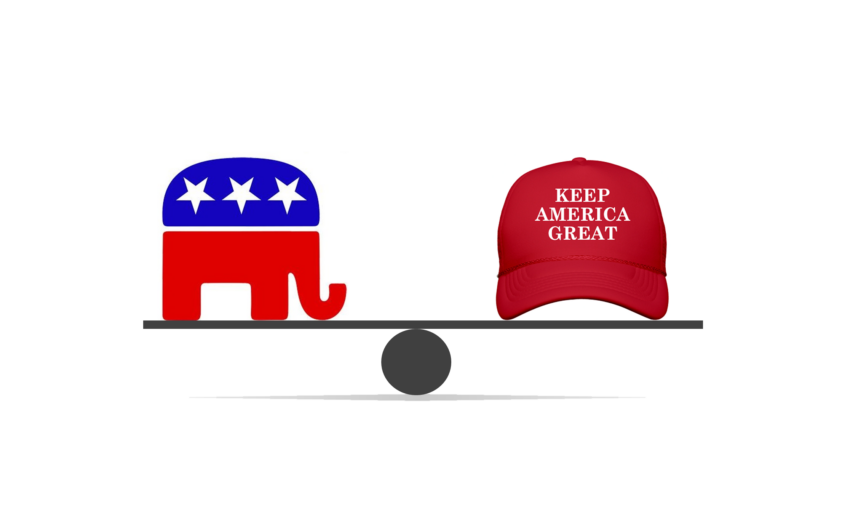
I had an interesting conversation with a friend of mine who closely follows the political scene and is an avid student of history. The topic was how much influence Donald Trump will have on the Republican Party after January, assuming he loses to Joe Biden in the November election.
My friend believes that Trump will still dominate the party even if he loses — that he will continue to hold a majority of Republican voters in his thrall so that any Republican office-holder who attempts to disavow him or his brand of politics runs the risk of being defeated by a primary challenger who swears allegiance to the former president. It’s a plausible scenario, especially now that Trump has demonstrated to other Republican office-holders how effective a fear- and hate-mongering approach to politics can be. And it’s not as if Trump’s policies are all that dissonant to most Republican office-holders. Many of them held positions similar to his even before he became president, though they may not have felt as free to espouse those positions as they do today.
Another view, one I’m more inclined to subscribe to, is that Trump’s hold on the party will diminish should he lose the election. While there will always be a core group of Trump supporters who maintain a fervent allegiance to him, I suspect many other Republicans will decide that Trump was the source of his own undoing. Even if they are largely approving of his policies, they will conclude that he is more of a detriment than an asset to the Republican Party. And if he loses by a large margin, there will be no escaping the ignominy attending that loss for a man who has branded himself as, more than anything, a winner.
But even if I’m right that Trump himself will lose his grip on the party, there is still the question of whether Trumpism will persist. Will Trump’s political worldview — his sympathy for white supremacy, contempt for immigrants, repudiation of America’s alliances, and rejection of the dangers of climate change — continue to dominate Republicans’ positions on domestic and foreign policy for the foreseeable future?
That would be a good-news/bad-news development for Democrats. The bad news is that it would be as difficult as ever to get any cooperation from Republicans in Congress for even moderately progressive legislation. The good news is that the demographic trajectory of the country points toward an increasingly diverse electorate that will be less and less sympathetic to the Trumpist worldview. Should Trumpism continue to dominate Republican politics, it may very well lock the party into a minority status for years to come. Until the party acknowledges the need to address systemic racism, reign in income inequality, strengthen the social safety net and deal with global warming, it will increasingly become an anachronism in American politics.
From one perspective, that could be good for America. Historically, we’ve made more progress as a country during times when one party or the other was relegated to minority status for a sustained period of time. Bipartisanship is most in evidence under such circumstances because the only way the minority party can obtain anything it wants is by making deals with the majority party.
But I can’t see the Republicans allowing that to happen. Were they to stick with a Trumpist platform at the expense of losing elections, they would lose the support of their wealthy donors, who view their donations as a way of ensuring that their interests are represented by those in power in Washington. Those donors would sharply curtail their support for a party that appeared destined to be in the minority for an extended period of time.
So I expect the Republican Party will evolve away from those aspects of Trumpism that are most abhorred by a younger and more diverse electorate. I can’t foresee just what mélange of policy positions and political interests will characterize the party in the future, but I suspect it will continue to do the bidding of the wealthiest Americans — our would-be oligarchs — while paying lip-service to the interests of the working class. That’s always been a tricky balancing act for the Republicans, and in the absence of the hate-fueled demagoguery that Trump provided, it will be interesting to see how the party pulls it off.