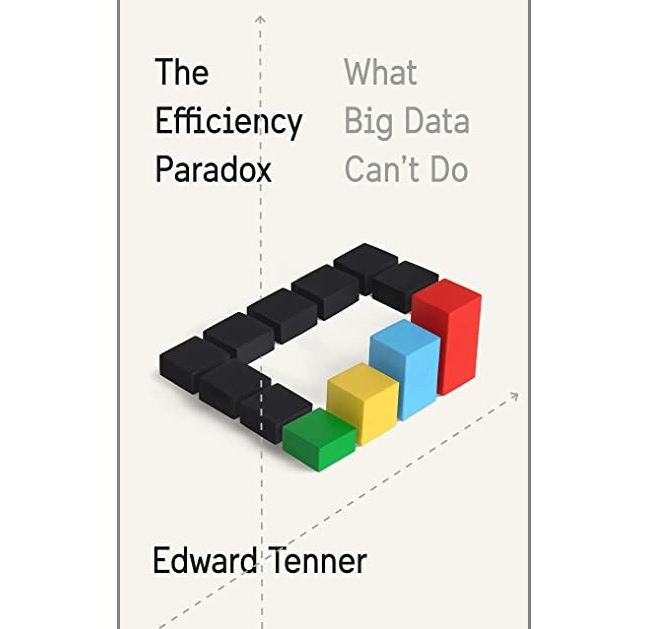
I just finished reading The Efficiency Paradox: What Big Data Can’t Do, by Edward Tenner. It wasn’t a compelling book. I struggled with what I might say about it and was tempted not to bother, but finally decided that since I’d spent hours reading it, I wanted to at least get a blog post out of it.
Let me start with this: The book does not live up to its subtitle. It is not an analysis of the limits of big-data analytics. Rather, it’s a meandering, almost stream-of-consciousness survey of the various ways that attempts to use information technology to improve efficiency have come up short, which is not exactly a revelation. (Tenner defines efficiency as “producing goods, providing services or information, or processing transactions with a minimum of waste.”) The book’s saving graces are how well-researched it is and the vast inventory of examples it provides. What’s disappointing are its vague thesis and rambling narrative structure.
Here’s the basic idea (though you’ll never find it articulated this concisely anywhere in the book): When innovators attempt to leverage digital technologies to make us more efficient, these efforts often:
- Succeed in improving efficiency but have undesirable consequences;
- Appear to succeed but only if we overlook hidden costs;
- Accomplish nothing of significance; or
- Actually make things worse.
Let’s take each of those in turn and look at some examples.
Technologies that improve efficiency but have undesirable consequences
An example of this is the widespread use of GPS devices and apps that provide turn-by-turn directions to drivers. There’s no question that these technologies help get us to our destinations more directly, and keep us from getting lost as often as we used to, but they result in our being less aware of our overall surroundings than we would from consulting a map. They also reduce the opportunities for serendipitously stumbling across something we weren’t looking for, which can be a benefit of more traditional “wayfinding.”
A major category of unintended consequences is the loss of human capabilities. Tenner writes about pilots who are not up to the task of flying a plane when the autopilot fails because they have less experience with manual flying than their forebears. He tells the story of a hiker who died after stepping away from the Appalachian Trail and not being able to find her way back because, even though she had a compass, she didn’t know how to use it. She assumed she’d be able to navigate the trail using the map app on her phone, and text for help if she got into trouble, but discovered she couldn’t get a signal in the remote part of Maine where she got lost. (Investigators learned what happened because she kept a diary of her month-long effort to get rescuers’ attention.)
Technologies that appear to make us more efficient but only if we overlook certain costs that their proponents don’t take into account
Electronic Health Records have improved the efficiency of transferring information from one medical provider to another, and eliminated medical errors resulting from physicians’ indecipherable handwriting, but it has resulted in doctors having to spend much more time doing data entry, leaving them with less time to spend with patients.
There are also costs associated with the use of IBM’s Watson to diagnose cancerous tumors. IBM spent more than a billion dollars on its development, and, Tenner cheekily notes, it uses 85,000 watts of energy compared to 20 watts for the human brain.
Technologies designed to make us more efficient that accomplish little or nothing
Efforts to bring technology into the classroom provide ample evidence of this phenomenon. Several generations of so-called teaching machines, which were supposed to guide students through an interactive learning process, typically showed few benefits. Tenner suggests that technologists consistently underestimate how expensive and time-consuming it is to develop such systems.
Technologies designed to make us more efficient that actually make things worse
Perhaps the most pernicious example of this is the “alarm fatigue” that plagues hospital staff. Manufacturers of medical devices, Tenner writes, “have strong incentives to issue alerts for every possible risk to the patient; if one is disregarded because there are too many, hospital staff, not the device manufacturer, will be held responsible.” But the result is that far more alerts go off in the typical ICU than the staff can deal with. Tenner cites the experience of Dr. Robert Wachter, professor of medicine and a pioneer of modern patient safety studies, who noted in his book The Digital Doctor that at his hospital at the University of California at San Francisco, “there was an average of one alarm every eight minutes for each of the 66 or so intensive care patients, a total of 15,000 each day and 381,560 each month for only one of the five alarm systems; together there were at least 2.5 million alerts each month in intensive care.”
If these examples of how technology can disappoint intrigue you and you’re interested in reading more of them — many, many more of them — you might enjoy this book. But don’t expect anything more cogent than a long litany of such examples.
In the ’80s, I got a fortune cookie in a New York restaurant that read: “Make use of all available technology.” I promptly bought a laptop I’d had my eye on, and I’ve never looked back. The advice itself was not perfect by any means, but it was good enough to convince me of the critical importance of pouring our nation’s resources, in this uncertain time, into fortune-cookie technology.