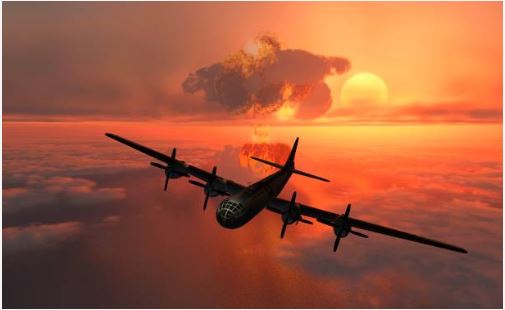
I just finished reading a new book by Chris Wallace and Mitch Weiss called Countdown 1945: The Extraordinary Story of the Atomic Bomb and the 116 Days That Changed the World. I was drawn to it because last year I read Nigel Hamilton’s FDR at War series, a three-volume history of Roosevelt’s conduct of WWII as Commander in Chief. That series ends with the death of FDR, but the war continued for another four months, and I thought Countdown 1945 would be a way of following it through to its conclusion. It was that and more.
I’m not going to attempt a full-blown book review here, but I do want to say that Wallace and Weiss did a great job. This was one of those books that kept calling me back to read as much as I could day after day until I’d finished it.
The book threads together the stories of a wide range of people who played a role in the development of the bomb and the decision to use it, including Harry Truman, Robert Oppenheimer, and Colonel Paul Tibbets who piloted the Enola Gay. But it also tells the stories of several other people who were profoundly affected by the decision to use the bomb, including a teenage girl in Hiroshima who survived the bombing but whose mother did not, and a Navy demolition expert who expected to play a perilous role in an invasion of the Japanese homeland, which would have taken place if the bomb had not been deployed.
In keeping with the book’s title, each chapter is titled with the number of days — and ultimately the number of hours, minutes and seconds — until the Hiroshima bombing. The final chapter, “Firestorm,” describes the hellacious detonation and the immediate aftermath, including the bombing of Nagasaki three days later and the Japanese surrender five days after that. A “Postscript” describes how the United States enforced a strict blackout on all information about the devastation from the bombings, and how the truth about them finally came out. And then an “Epilogue” wraps up the stories of each of the people introduced earlier, including those, like Truman, who expressed no regrets about their roles in the bombing, and others, like Oppenheimer, who were plagued by guilt.
The authors do not take a position on whether the use of the bomb (twice) in Japan was justified, but they do a creditable job of recounting the arguments made on both sides of that question, both before and after the bomb was deployed. They leave no doubt that Truman struggled with the decision.
But in addition to the issue of whether the bomb should be used, the other question that bedeviled Truman and his advisors was whether it would work. One of the alternatives advocated by those who opposed using such a destructive weapon on a populated target was doing a demonstration bombing, which might have persuaded the Japanese to surrender without the loss of thousands of lives. But one of the reasons Truman rejected that idea was that if the bomb failed, the Japanese might be encouraged to even more ferociously prosecute the war.
In short, Countdown 1945 is an illuminating and well-told story of a critical juncture in world history, and is every bit as propulsive a tale as its title suggests.