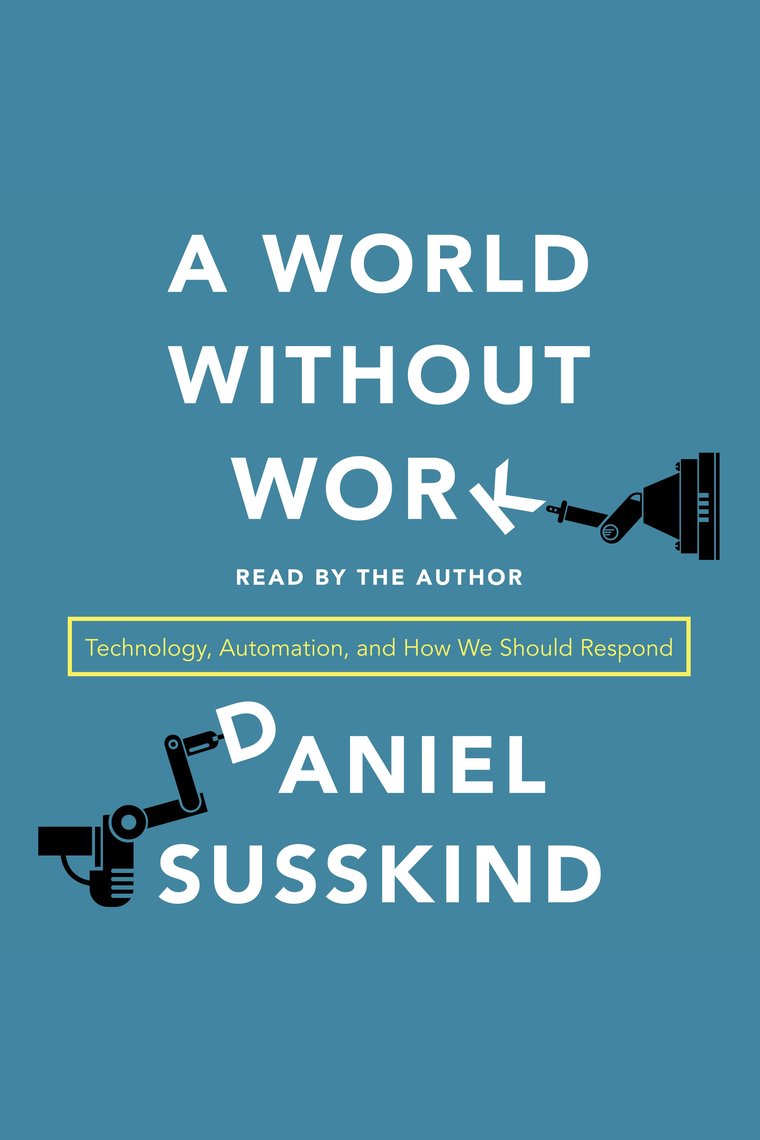
I just finished reading Daniel Susskind’s new book, A World Without Work: Technology, Automation, and How We Should Respond.
Susskind, an economist, has served as a policy analyst and advisor to the British government and is now a fellow at Balliol College. He believes that the time will come when there will be far fewer jobs than there are people to do them. He doesn’t believe this will happen suddenly, or in the very near future — nor does he believe that work for human beings will vanish entirely — but he asserts that the ability of computers and robots to displace human workers will gradually become so pervasive as to require a complete rethinking of how the fruits of our economy are distributed.
The book is a pleasure to read, and regardless of whether you entirely buy his argument, let alone his proposed solutions (which I’ll discuss tomorrow), Susskind does such a good job of explaining the relevant concepts and laying out his evidence that the book is required reading for anyone concerned about what the ongoing advances in technology, and especially artificial intelligence, will mean for the future of our labor economy.
Susskind begins by providing some historical context, tracing the history of humankind’s fears of being replaced by machines, which date back to the dawn of the industrial revolution. Time and again, Susskind writes, those fears turned out to be misplaced. Even as machines became capable of doing some of what human beings did previously, they also resulted in new types of jobs and expanded the size of the economic pie. The “substitution force,” in which technology replaces workers (think elevator operators and gas station attendants) has until now been balanced by a “complimentary force,” in which technology augments other human workers, enabling them to do more or do it better than they could before, thereby increasing the value of their labor.
But the current situation, Susskind suggests, is different, and the primary reason is artificial intelligence. It was once assumed that AI would be able to replace human beings only when it became capable of doing what human beings do the way human beings do them. But that turns out not to be the case. IBM’s Watson came up with the correct “questions” for many of Jeopardy’s pun-laced “answers,” not because it had a wry sense of humor and an intuitive knack for wordplay, but because it could do brute-force pattern-matching against a huge trove of data at speeds no human could match.
Similar capabilities have allowed AI systems to comfort people with dementia, outperform humans in telling the difference between a genuine smile and one of social conformity, and write music that experts mistake for a composition by Bach. None of these systems do these things in the same way that human beings would do them. Theirs is another route entirely.
So there may be many cognitive and interpersonal tasks that require capabilities unique to human beings, but only when they are performed by human beings. AI systems are often able to accomplish those tasks without uniquely human capabilities because they don’t need to do them the way human beings do them. Susskind writes that ignorance of that reality has led to an underestimation of “how far machines can encroach in those areas.”
While I wouldn’t say that Susskind definitively proves his thesis, he makes a compelling case. We ignore at our peril the possibility of a future in which there are paying jobs for only a fraction of those who want and need one.
Unlike some other economists who have raised concerns about “technological unemployment,” Susskind ventures to offer prescriptions for mitigating its consequences. I’ll talk about those tomorrow.