As anyone who knows me is aware, I’m a fan of David Allen, the personal productivity guru and author of Getting Things Done: The Art of Stress-Free Productivity. I’ve been a practitioner and proponent of Allen’s “GTD” methodology for more than 20 years, have had dinner with him twice, and attended his big “GTD Summit” in Amsterdam last year.
More recently I’ve been listening to a podcast called Deep Questions hosted by Cal Newport, another productivity expert and author of Deep Work: Rules for Focused Success in a Distracted World and Digital Minimalism: Choosing a Focused Life in a Noisy World. Like me, Newport is also an admirer of David Allen and endorses much of his GTD approach, but believes there’s one important thing Allen got wrong.
David Allen advocates managing your work and your life from a series of lists — five of them to be exact. He defines “list” loosely in that he considers your calendar to be one of those lists; it’s a list of everything you need to do at a particular time, he explains. The other four lists are Actions, Projects, Waiting For, and Someday Maybe. I’ll leave an explanation of the last three for another time and focus here on the Actions list, which is more or less what most people would call a To-Do list. It consists of all the actions you’ve decided you need to take.
To qualify for inclusion on the Actions list, an item must be something you can do in one sitting or single chunk of time, whether it’s five minutes or three hours. (If the task in question requires more than one step, Allen asserts, it’s not an action but a project, and belongs on your Projects list. What should go on your Actions list is the very next discrete, do-able action required to move that project forward.)
Allen makes explicit recommendations for how an Actions list should be categorized but I’m not going to get into that either. Suffice it to say that a day in the life of a GTD practitioner is driven off their calendar and the Actions list. In whatever time is not already spoken for on your calendar, you pick something off the Actions list to do next, based on considerations of importance, urgency, and how much time and energy you have at the moment, and you do it. When you’re finished you go back to the list and choose something else. In this way, Allen suggests, you’re able to happily crank through your day and get a lot of stuff done.
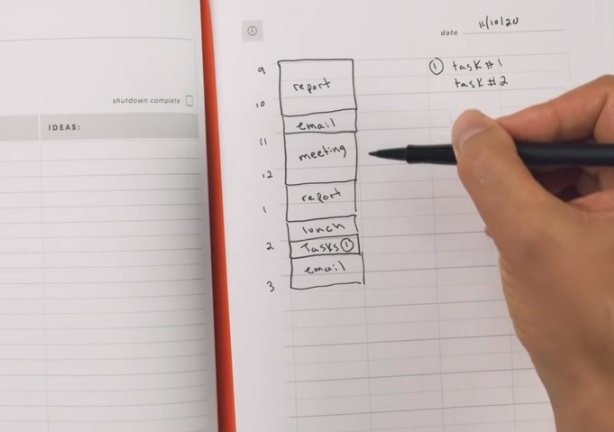
Cal Newport doesn’t endorse that approach, in particular for knowledge workers. For reasons that he describes at length on his podcast, he advocates what he calls “time blocking” instead. First, he says, it’s a mistake to assume that the complex and cognitively demanding nature of their jobs allows knowledge workers to break their work down into a linear series of discrete steps. It’s more productive to allocate blocks of contiguous time to the various projects and accountabilities they’re responsible for and focus intensively during each block on moving a particular piece of work forward.
Newport asserts that the “context switching” required to go back again and again to an Actions list, and doing one disparate task after another, reduces our effectiveness and wears us out. What’s more, he says, our moment-to-moment judgements about what to choose from that Actions list don’t necessarily add up to our making the best possible use of our day. It’s too easy to lose sight of the forest for the trees, and there’s too much of a temptation to pick the things that we’re most comfortable or confident about doing at the expense of the things that are most consequential. We’re much more likely to get the most important work done, and done well, if we make decisions at the start of the day (or the end of the day before) about how we’re going to allocate our time — “giving every minute of your day a job,” as Newport says.
I’ve personally experienced the adverse consequences Newport describes of the list-driven approach, so I was intrigued by his time-blocking alternative. And though I’m mostly retired, the fact that I’m still doing some personal productivity coaching, and am also interested in making the best use of my time, led me to experiment with Newport’s time-blocking approach in my own life. I’ve been doing it for three days now and the exercise has been illuminating. I’ll write about those insights tomorrow.