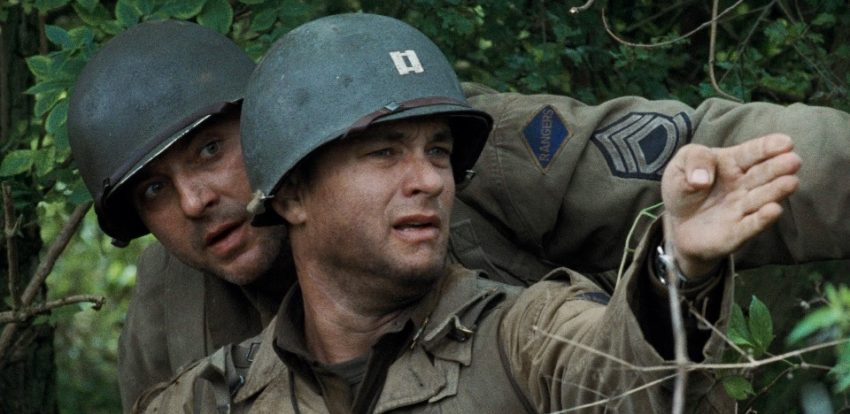
Given that I’ve seen a lot of movies, it has always seemed odd that I’d never seen Saving Private Ryan. I decided a few months ago that it was high time to redress that gap in my cinematic exposure so I added the movie to my Netflix DVD queue. It arrived a few weeks ago and then just sat on a table near the television.
I guess my lack of enthusiasm had to do with two things. First, what I’d heard most about Saving Private Ryan was that a 23-minute scene near the beginning of the movie depicting the D-Day landing by Allied forces on Omaha Beach in Normandy is unremittingly gruesome. I don’t have a particular problem with movie violence, but what I’d heard about that scene didn’t feel like a selling point. The other thing holding me back was that I’d seen a clip of the movie that gave away how it ends. Bottom line, while I had no doubt that the movie was a good one, and that I’d probably appreciate it when I finally got around to watching it, that DVD didn’t exactly call to me.
But the other day, being between books and with an entire evening open, I decided to put it in and watch it. I loved it. Once I’d endured the horrors of that long, bloody invasion scene, the tone of the movie changed and I found myself giggling at times, not because it was especially funny but just because of how much I was enjoying it.
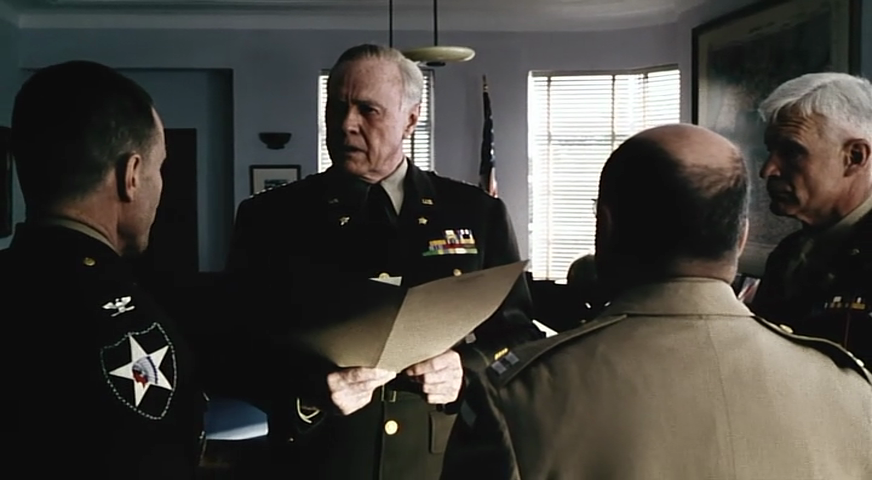
The scene that most stuck with me was set at Army Headquarters in Washington, D.C. Whether or not you’ve seen Saving Private Ryan, you probably know something about its premise: three of four brothers are killed during the D-Day invasion. Their mother is notified of all three deaths on the same day. She has one other son, a paratrooper named James Francis Ryan, who was also part of the invasion but whose whereabouts are unknown. Officers in the war department bring news of this development to General George C. Marshal, U.S. Army Chief of Staff, and suggest that someone be sent into Normandy to find the missing Private Ryan so he can be sent home, sparing his mother the possibility of enduring the loss of all four of her sons.
One officer, apparently a senior aide to General Marshall, argues that sending troops into harm’s way to retrieve a single soldier would be a misallocation of resources, and perhaps even fruitless; Private Ryan, he argues, is likely already dead.
Marshall turns to his credenza and pulls out a piece of paper that he keeps tucked into a book. It’s a letter, he explains, written a long time ago to a Mrs. Bixby in Boston. He then proceeds to read it. Half-way through, I recognized the writing style and realized whose letter it was. When the movie was over I went back to that scene and transcribed the letter.
Dear Madam,
I have been shown in files of the War Department a statement of the Adjutant General of Massachusetts that you are the mother of five sons who have died gloriously on the field of battle.
I feel how weak and fruitless must be any words of mine that would attempt to beguile you from the grief of a loss so overwhelming, but I cannot refrain from tendering to you the consolation that may be found in the thanks of the republic they died to save.
I pray our heavenly father may assuage the anguish of your bereavement and leave you only the cherished memory of the loved lost and the solemn pride that must be yours to have laid so costly a sacrifice upon the altar of freedom.
Yours very sincerely and respectfully,
Abraham Lincoln
Marshall then turns to his officers and says, “That boy’s alive. We are going to send somebody to find him, and we’re going to get him out of there.”
Yesterday, I was telling my mother about the movie and read her Lincoln’s letter. I couldn’t get through it without choking up. Some people really know how to make the most of the English language.